
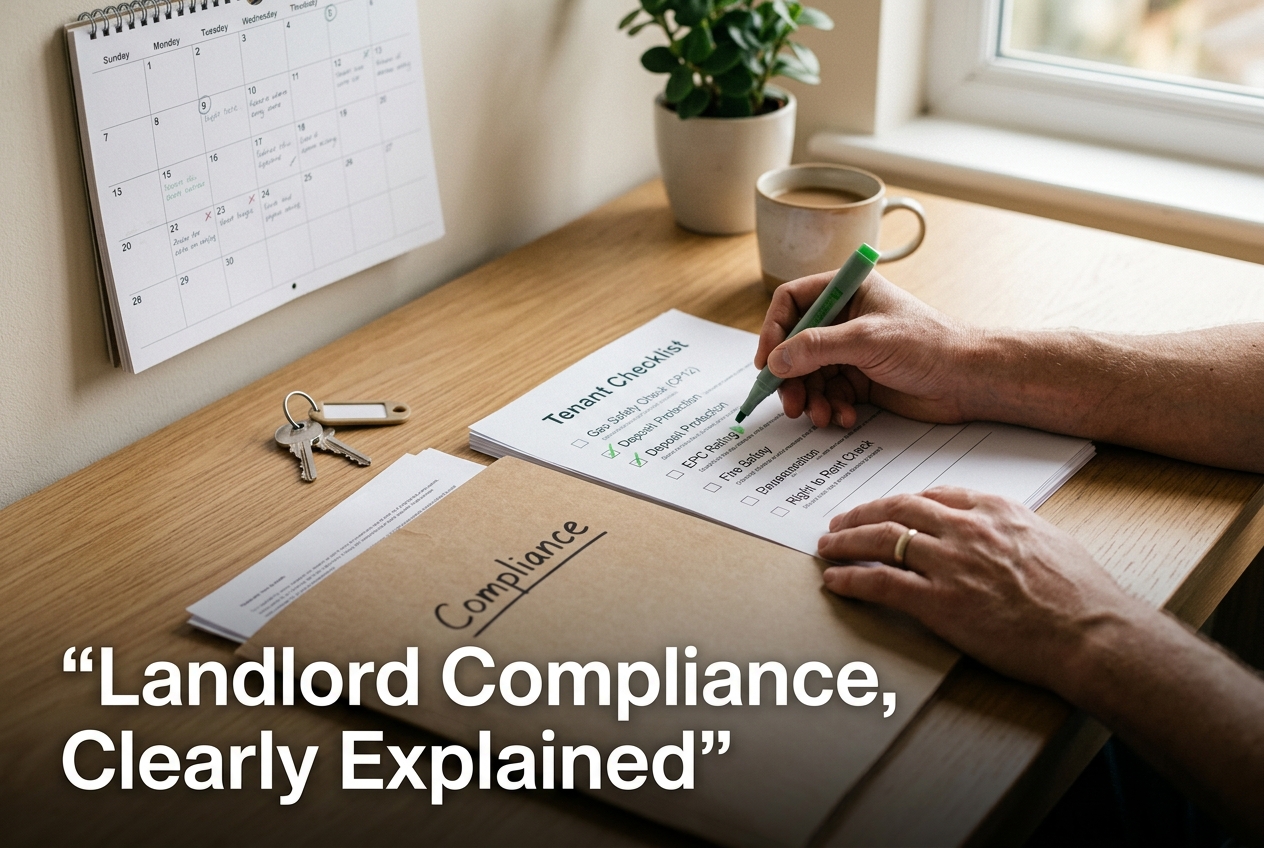
Landlord compliance means meeting the legal requirements that apply to the property, the tenancy, and the way you let and manage it. It covers safety, repairs, certificates, deposits, tenant checks, fees, licensing, records, and changing tenancy rules. It is bigger than having a gas certificate in a folder.
If that sounds broad, that’s because it is. The hard part is not one task. It’s that different duties sit on different clocks, and some apply to the building, some to your conduct, and some to the evidence you keep.
What does landlord compliance actually cover?
It covers four things at once: the property, the tenancy, your conduct, and the evidence. That’s the cleanest way to think about it.
The property has to be safe, habitable, maintained, energy-rated where required, and licensed where the rules say so. The tenancy has to be set up correctly, with the right checks, documents, deposits, and fees. Your conduct matters too. You need to repair faults, treat applicants fairly, respect access, and follow the rules around rent, pets, and possession. Then there’s the evidence. You need to be able to show what was checked, when it was checked, who did it, what was given to the tenant, and what happened when a problem was found.
That’s why landlord compliance can look fine on the surface and still be shaky underneath. You can have a current gas safety record and still have an unprotected deposit, an expired EPC, an unresolved repair, or an unlawful tenant fee.
So when people ask what is landlord compliance, the short answer is this: it’s ongoing legal fit, not a one-time certificate.
Why does landlord compliance feel so overwhelming?
Because it isn’t one rulebook. It’s a stack of them.
A typical let can involve national housing and safety rules, gas and electrical checks, fire safety, repairs and health hazards, energy performance rules, deposit protection, right to rent checks in England, permitted tenant payments, anti-discrimination rules, tenancy and possession rules, local HMO or selective licensing, mortgage and insurance conditions, and separate tax and record-keeping duties.
That’s a lot even before you get to the part where the rules do not all run on the same schedule. Gas checks are annual. Electrical inspections are at least every five years under current England guidance. EPCs last 10 years. Deposits must be protected within 30 days of receipt. Repairs are event-driven. Right to rent checks happen before the tenancy starts. Licensing depends on the property and the local area. And rental property legislation changes on a national timetable, not yours.
That mix is why tenancy regulations feel hard to hold in your head. You are not forgetting one annual task. You are trying to track several legal systems at once while also running a property business.
How does landlord compliance work over a tenancy?
The easiest way to understand it is as a cycle.
Before you market the property
Before you advertise, you need to know which rules apply to that property and tenancy. That includes whether an EPC is required and current, whether the property needs a licence, whether safety checks are up to date, whether the mortgage lender allows letting, and whether your advert and rent approach fit current tenancy rules.
An EPC has to be ordered before you market a property to rent. It rates the home from A to G and is valid for 10 years. If the certificate has expired or the property doesn’t have one, you need a new EPC. The exact current minimum energy-efficiency threshold for letting was not confirmed in the research, so that’s not something to guess at.
Before the tenancy begins
This is where the administration gets serious. You need the right-to-rent checks for adult tenants in England before the residential tenancy agreement is entered into. If the property has gas, you need the gas safety paperwork. You need electrical safety dealt with. You need smoke and carbon-monoxide alarms where required. You need the tenancy information, the deposit process, and any HMO or local licence requirement handled properly.
The important bit here is that “the property is ready” and “the tenancy paperwork is complete” are not the same thing. You need both.
During the tenancy
Compliance does not stop once someone moves in. You still need to keep the property safe, do recurring checks, respond to repairs, and handle tenant requests without creating a new legal problem.
This is where a small leak or a faulty alarm stops being a maintenance issue and starts becoming a compliance issue. So does ignoring mould reports. So can mishandled access requests or a dispute over pets or rent.
If you’re busy, this is usually where things slip. Not because you don’t care. Because these are the tasks that arrive in fragments, between everything else.
At changeover
When a tenant leaves, the work doesn’t end. You may need an inspection, cleaning, repairs, safety work, deposit deductions, document updates, a new right-to-rent check, and a new tenancy agreement.
This is the point where speed tempts people into shortcuts. Don’t. A quick re-let is useful only if the new tenancy is lawful and properly documented.
Which compliance areas matter most?
You do not need to memorise every law to stay on top of the basics. You do need to know which areas are doing the heavy lifting.
General safety and health hazards
Landlords must keep rented properties safe and free from health hazards. Councils use the Housing Health and Safety Rating System to assess hazards. It looks at 29 health and safety areas and classifies hazards as Category 1 or Category 2, depending on seriousness.
If a council finds a serious hazard, it may issue an improvement notice, arrange for the hazard to be fixed and bill the landlord, or restrict use of part or all of the property.
The plain-English point is this: a property can be full of certificates and still be unsafe. Unsafe stairs, damp, poor heating, or dangerous electrics can still create a real problem.
Gas safety
If you supply gas equipment, it has to be safely installed and maintained by a Gas Safe registered engineer. There must be an annual gas safety check on each appliance and flue. The tenant must get a copy of the gas safety record before moving in or within 28 days of the check.
Treat that as a recurring duty, not as a box you tick once and forget.
Electrical safety
The electrical system has to be safe, including sockets and light fittings, and any appliances you supply must be safe too. Current England guidance says rented-property electrics must be checked at least every five years by a properly qualified person.
The inspection is not the finish line. If the inspection identifies danger or work that needs doing, that still needs to be handled and evidenced.
Smoke, carbon-monoxide, and fire safety
You’re responsible for fitting and testing smoke alarms and carbon-monoxide alarms. The guidance says there must be a smoke alarm on each storey and a carbon-monoxide alarm in any room with a solid-fuel burning appliance, such as a coal fire or wood-burning stove.
You also need to follow fire-safety rules, keep escape routes accessible, make sure furniture and furnishings are fire safe, and provide fire alarms and extinguishers where required for a large HMO.
Repairs, damp, and mould
You are always responsible for repairs to the structure and exterior, sinks and basins and other sanitary fittings, heating and hot water, gas appliances and ventilation, electrical wiring, and any damage caused by your attempt to carry out repairs. Common areas are usually your responsibility too, depending on the tenancy setup.
Tenants are responsible for damage caused by them or by their family or friends. They cannot be forced to do repairs that are your responsibility.
This is one of the biggest compliance pressure points because it is about timing, not just duty. If you don’t respond to a repair or mould report, a council environmental health team may get involved where problems could harm occupants or cause a nuisance. You also need to manage access properly, usually with at least 24 hours’ notice and at a reasonable time unless there’s an emergency.
EPCs
An EPC tells you how energy efficient a property is. It uses an A-to-G scale and lasts 10 years. You need one before marketing a property to rent, and you have to show it to prospective tenants.
There are exemptions for certain kinds of property, including some temporary buildings, some small standalone buildings, some low-energy industrial or agricultural buildings, some buildings due for demolition, some holiday accommodation, some properties used for less than four months a year, and certain listed buildings. Those exemptions are specific, not a free pass for odd homes.
The safe way to think about an EPC is simple. Having one, showing one, and meeting any separate minimum letting rule are related, but they are not the same thing.
Tenancy deposits
For covered assured periodic tenancies in England, the deposit has to go into a government-approved scheme. The approved options listed in the research are the Deposit Protection Service, MyDeposits, and the Tenancy Deposit Scheme.
The deposit must be protected within 30 days of you or your agent receiving it. If someone else pays it, such as a rent-deposit scheme or a parent, the same rule still applies once it becomes a tenancy deposit.
A holding deposit is different. It doesn’t need protecting before the tenancy agreement is signed. Once it becomes a tenancy deposit, the protection rule kicks in.
Right to rent in England
Right to rent checks apply in England. They must be carried out on all adult tenants before a residential tenancy agreement is entered into, regardless of nationality or ethnicity.
This is a legal eligibility check, not a general tenant-quality check. It must be handled consistently. You should not use it as a reason to treat applicants differently.
Tenant fees and permitted payments
The Tenant Fees Act framework limits what you can ask a tenant to pay. The permitted categories listed in the research are rent, a refundable tenancy deposit, a refundable holding deposit, a payment when the tenant asks to change the tenancy, a payment when the tenant leaves without enough notice, payments towards utilities and communication services, a late-rent payment, and a charge for replacing a key or security device.
Anything outside those categories is a prohibited payment.
Licensing and HMOs in Chester
In Cheshire West and Chester, some HMOs require a licence. The council says a licence is required when five or more unrelated people are sharing in the relevant mandatory-licensing context.
That matters because not every shared house is automatically a licensable HMO. The occupancy pattern, number of people, households, property type, and local rules all matter.
The council also says its HMO licence conditions cover property management, fire safety, kitchen facilities, bathroom facilities, room sizes, and waste disposal. Accredited landlords may claim a 10% reduction on the HMO licensing fee, but the fee amount itself was not stated in the material reviewed.
What changed under the Renters’ Rights Act, and why does it matter?
This is one of the main reasons rental property legislation feels like it keeps moving.
The live 2026 information-sheet requirement applies in England where the tenancy is an assured or assured shorthold tenancy, was created before 1 May 2026, and has a wholly or partly written record of terms. The deadline was 31 May 2026, and the stated maximum fine was £7,000.
The sheet has to be given to each tenant named on the agreement. It can be hard copy or an electronic attachment. A link on its own is not enough. If a managing agent handles the property, the agent has to provide it. Lodgers do not need it.
The current rental-discrimination guidance also matters. Landlords and people acting for them must not make families with children or people receiving benefits less likely to get a tenancy. You can still assess affordability and sustainability, but you have to apply income requirements consistently and treat different forms of income equally.
A local authority may issue a civil penalty of up to £7,000 for a first breach. The guidance also allows for additional penalties for repeated or continuous breaches.
The other reforms are part of the same story, but this is where you need to be careful. Rules change through Acts, commencement dates, regulations, court decisions, and updated guidance. A passed Act is not the same thing as a live duty on the date you read about it.
What do landlords usually get wrong?
The same misunderstandings come up again and again.
Compliance is not the same as property management
Property management is the practical work that helps you comply. Compliance is whether the legal duties are actually being met.
Good management lowers risk, but it is not proof of compliance by itself.
A certificate is not the same as a safe property
A certificate records one inspection at one point in time. It doesn’t replace repairs, and it doesn’t cover unrelated hazards.
A gas safety record does not cover unsafe wiring, damp, broken alarms, or dangerous stairs.
National rules are not the whole picture
England-wide rules still sit alongside local authority powers. A Chester landlord has to think about Cheshire West and Chester Council as well as national tenancy regulations.
Right to rent is not tenant vetting
Right to rent is about legal eligibility to rent in England. Referencing, affordability, and past landlord checks are separate. Keep them separate so you do not create a discrimination problem.
An HMO is not just “a house with housemates”
Shared homes are not all the same. The classification depends on who lives there, how they’re related, the property type, and the local rules. In the Cheshire West and Chester context, the council’s licensing trigger is five or more unrelated people sharing in the relevant mandatory-licensing context.
Using an agent doesn’t remove your responsibility
An agent can help with tenant finding and vetting, communication, site visits, and maintenance coordination. But you still need to understand who is responsible for what and make sure the evidence is being kept.
What can you judge now?
At this point, you don’t need to master every rule. You need to know what kind of problem you’re actually dealing with.
Is it a knowledge problem, where you’re not sure what applies to the property? Is it a time problem, where you know the tasks but can’t keep up with them? Is it a coordination problem, where tenant messages, access, contractors, and documents are falling between the cracks? Or is it a property-condition problem, where the building itself needs attention?
That’s the useful question. It tells you whether you need a better system, a better process, or more hands on the work.
How Address fits into that picture
If the pressure point is not knowing where to start, or not having the time to keep everything moving, Address can help with the parts that most often slip.
Address works with landlords and deals with tenancies. It finds and vets suitable tenants, maintains communication with tenants, conducts frequent site visits to help keep properties in good condition, coordinates property maintenance, and provides information about renting and legalisation updates. It also offers sales, lettings, and full management services.
That doesn’t replace your legal responsibility, and it doesn’t turn compliance into a one-click job. But it can reduce the day-to-day load if the real problem is coordination, follow-up, and staying informed as tenancy regulations change.
FAQ
What is landlord compliance in simple terms?
It means keeping the property safe, handling the tenancy lawfully, treating applicants and tenants fairly, completing required checks, and being able to show what was done. It is broader than holding a gas certificate.
Do landlord compliance rules run once a year?
No. Different duties run on different schedules. Gas checks are annual, electrical inspections are at least every five years, EPCs generally last 10 years, deposits must be protected within 30 days, and repairs are triggered by events and hazards.
Does using a letting agent remove the landlord’s responsibility?
No. An agent can do a lot of the work, but the landlord still needs to understand the setup, confirm who is doing each task, and make sure evidence is retained.
Do all shared houses in Chester need an HMO licence?
No. The Cheshire West and Chester Council page says a licence is required when five or more unrelated people are sharing in the relevant mandatory-licensing context. The exact classification for a property still has to be checked against the current rules.