
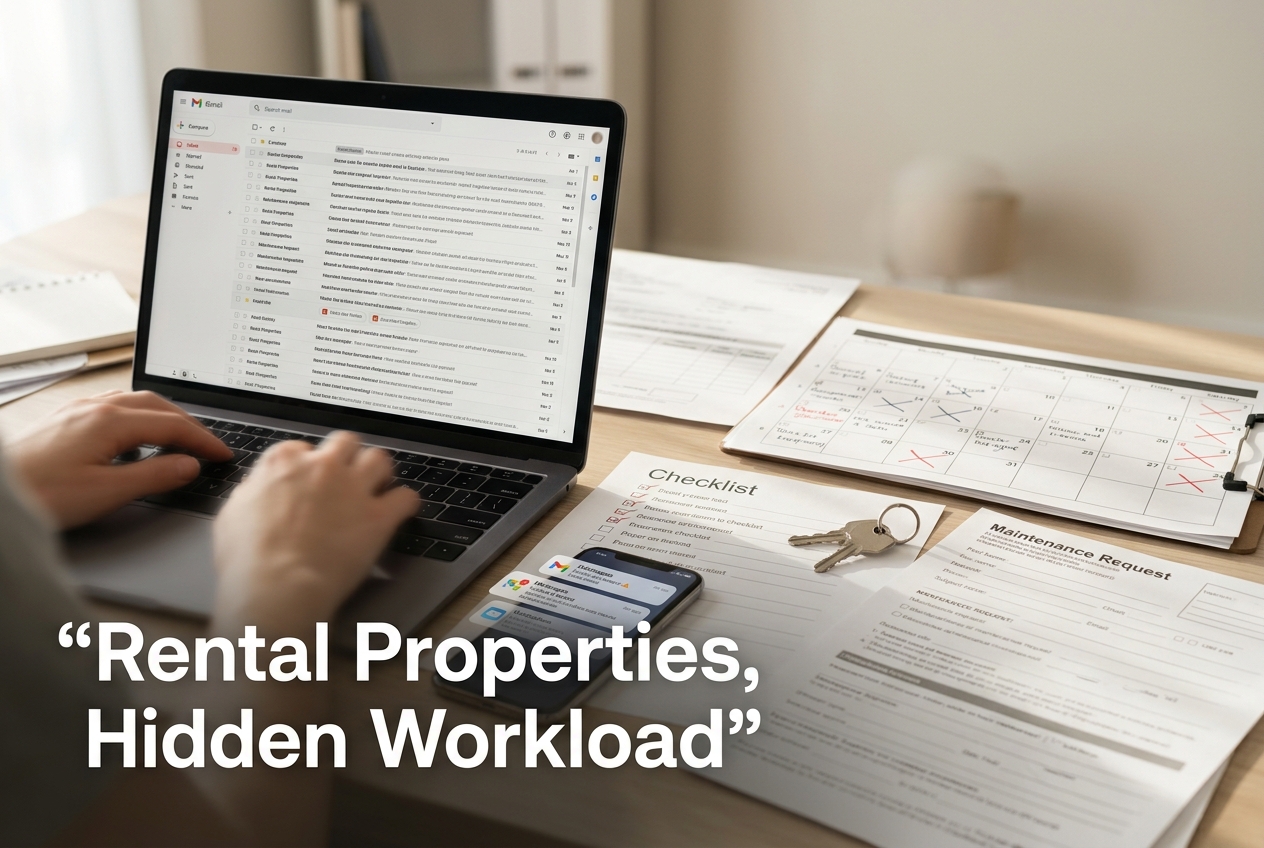
A few rental properties can feel like a full-time job because every occupied home creates an ongoing service obligation. You’re not just owning assets. You’re handling tenant messages, access, repairs, records, and follow-up, often around other people’s schedules. That’s why the work can swallow evenings and weekends even when the portfolio is small.
Why do a few rental properties create so much work?
The short answer is that occupancy starts the management job, it doesn’t finish it. Once a property is let, you’ve got open workstreams, not a finished task. Each home can generate its own messages, appointments, decisions, and records, and those things rarely arrive one at a time.
That’s the real landlord workload. It’s not just the building. It’s the coordination around the building.
A useful way to think about it is this:
- recurring obligations, like safety checks and records
- issue handling, like working out what a tenant report actually means
- coordination and follow-up, like access, contractor timing, and updates
- tenancy transitions, like notice, viewings, and re-letting
Add one more occupied property and you add one more set of obligations. Not every extra property adds the same amount of work, but it does add another place where something can need attention. If you already have a full-time job, that’s where the pressure comes from. Not one huge crisis, just several ordinary crises overlapping.
How does one tenant message become several tasks?
A tenant message becomes work when it needs more than one reply. That’s the part people miss. A first report is often the start of the job, not the job itself.
If a tenant says there’s water under the sink, you may still need to work out what’s happening, whether it’s ongoing, whether there’s a wider issue, who should attend, and when they can get in. Then there’s the follow-up. Did the problem stop? Did the contractor need a return visit? Does the tenant need another update?
That is why tenant repairs feel heavy even when the fault itself is small. The message creates a chain of actions:
- acknowledge the report
- ask for useful details if needed
- decide what kind of response is needed
- contact the right contractor
- agree access
- keep the tenant updated
- check the outcome
- chase anything that’s still open
None of that means tenants are being difficult. Reporting a problem is often what protects the property. The burden comes from managing the response, not from the fact that someone spoke up.
This is also where landlord workload starts to feel bigger than the number of properties suggests. One issue may create several rounds of communication because the tenant, the contractor, and you each need different information. One person wants to know what happens next. Another needs enough detail to attend. You need to know whether to approve, wait, or escalate.
Why do repairs take more time than the repair itself?
Because a repair is a small management project, not just a trade visit. Before anything gets fixed, someone has to triage the problem, choose the right response, arrange access, and keep the thread alive until it’s actually closed.
That matters even more with tenant repairs, because not every report is the same kind of problem. A possible safety issue needs a different response from a routine maintenance job. A loss of heating is not the same as a loose handle. A repeat report may mean the first repair didn’t solve the real issue.
The management question changes with the problem:
| Type of report | What you have to figure out |
|---|---|
| Possible safety issue | Does this need urgent attention or specialist assessment? |
| Loss of an important facility | How serious is the impact on the occupied home? |
| Continuing leak or deterioration | Is damage spreading or getting worse? |
| Routine maintenance issue | What work is needed and when can access happen? |
| Repeat report | Is this the same unresolved problem or a new one? |
A contractor’s attendance does not automatically mean the matter is resolved. Someone may have visited, diagnosed the issue, or made it safe, but the work can still be open if there’s more to do, more to agree, or more to check.
That’s where records matter. If you can’t quickly see what was reported, who attended, what they found, and what remains outstanding, you end up reconstructing the same context twice. That’s not just annoying. It keeps the issue open in your head.
Why is access coordination its own job?
Because owning the property doesn’t mean you can move through it freely. In an occupied home, access is a three-way coordination problem. You have the tenant’s schedule, the contractor’s diary, and your own decision-making to align.
For inspections and repairs in England, guidance says landlords need at least 24 hours’ written notice and a reasonable time of day. It also makes clear that holding a key doesn’t give you a free pass to enter without permission. Notice is not the same thing as automatic access.
That distinction creates real work. A first appointment offer may not suit the tenant. A contractor may reschedule. A diagnostic visit may lead to a second visit for the repair itself. The tenant may stay in the property while the work is done. Each of those changes can reopen the coordination loop.
And this is where a lot of small landlords get stuck. They assume the hard part is finding a tradesperson. It isn’t. The hard part is arranging a workable visit, then managing the changes that come after that.
You also have to keep access types separate. Repair access is not the same as viewings, and not every tenancy arrangement works the same way. So if you’re trying to line up a repair and a re-let at the same time, you’re dealing with two different sets of rules and two different sets of people.
Why is compliance an ongoing administrative job?
Because compliance is not a one-time fact you learn and move on from. It’s a sequence of appointments, documents, updates, and records that keep landing on the calendar.
A few examples make the point:
| Example | What it means for your workload |
|---|---|
| Gas safety | You need the check arranged, access agreed, the record received, and the tenant given the record in time |
| Electrical safety checks | Even longer-cycle checks still need future planning and record-keeping |
| Property condition | Monitoring doesn’t stop just because the tenancy is already in place |
The work grows again when rules change during an existing tenancy. The Renters’ Rights Act is a good example. The main tenancy reforms took effect on 1 May 2026. For covered private tenancies, assured periodic tenancies replaced the old assured shorthold tenancy framework. Existing written tenancies did not have to be replaced just because of the reform, but landlords had to give tenants the government’s Renters’ Rights Act Information Sheet by 31 May 2026. Where the tenancy was entirely verbal, written information about the key terms had to be provided by the same date.
That’s not a small thing for a time-poor landlord. It means compliance is not just about knowing a rule exists. It’s about noticing when it applies, acting on time, and keeping track of what was sent.
The same is true of rent increases, pet requests, and other changes under the new framework. The point here isn’t to turn this into a legal guide. It’s to show why compliance adds to landlord workload even when the property itself looks quiet.
Is finding tenants the same as managing a property?
No. Tenant finding solves the start of the tenancy. Ongoing property management handles everything that happens after move-in.
That difference matters because a let property is not a finished job. It becomes a live relationship. Once the tenant moves in, you still have communication, condition checks, maintenance coordination, and compliance administration to handle.
This is where people often overestimate the value of getting the tenant in and underestimate the work after that. A suitable tenant helps, of course. But even a solid tenancy still needs:
- clear communication
- access arrangements
- repair coordination
- safety records
- follow-up when something changes
In other words, tenant finding reduces one kind of work. It does not remove the rest.
If you’ve got a growing portfolio, that’s the part that starts to feel like a second job. Not the sourcing itself. The ongoing upkeep of the tenancy once it’s occupied.
What makes a small portfolio manageable?
A small portfolio is manageable when you can see the open loops and keep them from stacking up. The number of properties matters less than the number of active threads you’re carrying at once.
That’s why a landlord with three occupied homes and a full-time job can still feel stretched. One property has a leak report. Another needs a gas safety appointment and record. The third has just had notice. None of those situations is unusual on its own. Put them together, and you’re switching contexts all day.
If you want a simple test, ask yourself what is actually filling your evenings:
- message handling
- access coordination
- repair follow-up
- compliance admin
- tenancy transition work
- remembering what still needs chasing
If it’s one or more of those, the issue isn’t that your properties are failing. It’s that occupied homes create ongoing work, and that work doesn’t always fit neatly around another career.
If the day-to-day management is competing with your other work, a conversation about which responsibilities you want help with is a sensible place to start.
That’s where support can help. Address can help with tenant finding and vetting, ongoing tenant communication, frequent site visits, maintenance coordination, and updates on relevant legislation. If the day-to-day management is competing with your other work, a conversation about which responsibilities you want help with is a sensible place to start.
Frequently asked questions
Why can two or three rental properties feel like a full-time job?
Because each occupied home creates its own messages, repair decisions, access arrangements, and recurring admin. Those workstreams can overlap and interrupt your other work, even if they don’t add up to a literal full-time week.
Why do tenant repairs involve so much chasing?
Because a repair is more than paying for a tradesperson. Someone still has to understand the report, decide what response is needed, arrange access, communicate changes, and check whether the issue is actually resolved.
Can a landlord enter after giving 24 hours’ notice?
Not as an automatic rule. Guidance for England says landlords need at least 24 hours’ written notice for inspection or repair access, and they should not enter without permission simply because they have a key.
What’s the difference between tenant finding and ongoing property management?
Tenant finding is about securing and vetting a tenant. Ongoing property management is what happens after move-in, including communication, maintenance coordination, site visits, and compliance admin.