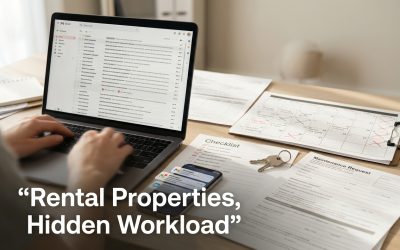
Delegating property management means authorising someone else to handle defined landlord tasks, like tenant communication, repair coordination, inspections, and maintenance follow-up, within agreed limits. The point is to remove the interruptions that eat your evenings while you keep control of the decisions that matter.
If you’re a time-poor landlord, the first thing to hand off is usually the work that keeps coming back, not the work that looks biggest on paper. For most landlords, that starts with routine tenant messaging and the full repair-coordination loop. If access, travel, and recording visit findings are the main drain, routine inspections become the next sensible hand-off.
Which landlord tasks create the most daily management load?
The tasks that drain you fastest are the ones that interrupt you, create back-and-forth, and leave something unresolved in your head. A short message from a tenant can turn into a chain of calls, access arrangements, contractor questions, and a later chase if no one owns the next step.
That is why the right place to start is not always the task that takes the most time in one sitting. It is the one that keeps breaking into your day. For many landlords, those are the core landlord tasks that repeat without warning:
- tenant messages and follow-up questions
- repair reports and contractor coordination
- access arrangements for visits and works
- recurring reminders to check whether something was actually finished
- routine inspections and condition notes
It helps to separate the work into three buckets:
- Interruptions, like calls, texts, and urgent decisions
- Coordination, like arranging people, access, quotes, and timing
- Open loops, like unfinished jobs you still have to remember and chase
That split matters because forwarding messages is not the same as reducing your daily management load. If you still have to decide, chase, and close the loop yourself, you have only moved the inbox.
Tenant communication and repair coordination
Tenant communication is often the best first task to delegate because it sits at the front of everything else. When you are the first contact for every report, you become the default organiser for every small problem too.
Delegating this work means more than giving someone access to your inbox. It means letting them receive routine reports, gather the details needed to act, answer ordinary questions, arrange appointments, and keep the tenant updated while the issue moves forward.
A useful communication process can include:
- a named contact route for ordinary questions and repair reports
- acknowledgement that the report was received
- collection of the details needed to assess the issue
- identifying urgent matters or issues needing landlord approval
- arranging access and appointments
- updating the tenant when plans change
- keeping a record of what was reported and what happened next
For repair reports, the useful details are the property, the affected area, when the issue started, whether it is getting worse, and anything that affects access or urgency. That is enough to move the issue forward without making the tenant repeat themselves.
Repair coordination is the same kind of burden, just with more moving parts. It is not only about booking a contractor. It covers assessing urgency, choosing the right trade, arranging access, getting quotes where needed, monitoring attendance, checking delays, and making sure the issue is still open if the fault returns.
This is where most landlords feel the strain. One repair can create several separate landlord tasks, and each one can land at a different time of day. If you stop doing the coordination yourself, you usually feel the difference quickly.
What weak delegation looks like
Weak delegation is easy to spot:
- every tenant message still reaches you first
- the tenant has to chase more than one person
- no one owns the next action
- the contractor is booked, but the issue never closes out
- you keep asking whether anything has happened
That setup does not reduce your workload much. It just spreads the confusion around.
What good delegation looks like
Good delegation gives you a decision-ready summary only when a real decision is needed. You get the issue, the apparent urgency, the proposed response, and the approval point if one exists. Routine updates can be grouped together instead of landing one by one.
If your phone keeps pulling you out of work or family time, this is the first area worth handing off. Tenant messages and repair coordination are the quickest way to reduce the daily management load without giving up control of major decisions.
Inspections and maintenance follow-up
Routine inspections help most when they are part of a wider management process, not a stand-alone visit. If someone can arrange access, attend, record what they saw, and then make sure the findings lead to action, the visit earns its place. If the visit ends with a photo and no next step, it does not help much.
Delegating inspections means handing over the scheduling, access arrangements, attendance, and reporting. It is useful when travel and diary management are the problem. It is less useful if nobody follows through on the findings.
A solid inspection report should identify:
- the visit date and property
- the rooms or areas seen
- any access limits
- visible findings that matter
- relevant photographs where appropriate
- matters raised by the tenant
- suggested or required action
- who owns each next step
That last point is the one people miss. A visit only reduces stress if it leads to action. Otherwise, it just gives you another document to store.
Maintenance follow-up belongs in the same conversation. Once a contractor has attended, someone still needs to confirm what was done, check the evidence, update the tenant, and decide whether the issue is actually finished. If the fault returns, it should reopen, not quietly disappear from view.
Why follow-up matters
Follow-up is the difference between “someone came out” and “the problem is no longer mine to remember.” That sounds small, but it is where a lot of landlord frustration sits.
Good follow-up can include:
- confirmation that attendance happened
- a clear note of the work carried out
- completion information, photos, or certificates where relevant
- a tenant update and a chance to report continuing symptoms
- a record of delays, repeat faults, or unresolved questions
- escalation if the same issue comes back
A repair is not really closed just because a contractor visited. If the issue returns, it needs more than another note in a file. It needs further action.
A useful example
Say a tenant reports damp in a room. A weak process might keep the problem at the level of photos and messages. A better process records the finding, gets the right assessment, assigns the next action, and checks whether the fix worked. That is the kind of follow-up that protects both the property and your time.
If your main burden is worry rather than volume, inspections and maintenance follow-up are the landlord tasks to move next. They are what stop small issues from sitting on your mental to-do list for weeks.
How delegated property management actually works
Delegated property management works when the scope is clear. One person handles the routine work, exceptions get escalated, and records show what happened. It is not about removing yourself from the picture. It is about keeping yourself out of the constant back-and-forth.
The basic model is straightforward:
Routine work sits with the appointed manager, exceptions and reserved decisions come to the landlord, and the record shows what happened.
That means the arrangement needs boundaries. The important ones are:
| Boundary | What it needs to define |
|---|---|
| Contact ownership | Who receives tenant reports and stays responsible until the issue is resolved or escalated |
| Routine authority | Which questions, arrangements, and maintenance decisions can be handled without another approval |
| Spending | What can be instructed, how the limit is calculated, and when further approval is needed |
| Emergencies | Who acts outside normal hours and when the landlord cannot be reached |
| Reporting | Which matters need prompt notice and which can go in a summary |
| Technical competence | Which work needs a qualified specialist rather than general coordination |
| Completion | What evidence is needed and who checks unresolved or recurring issues |
| Records | Where messages, reports, approvals, invoices, and certificates are kept |
That is the part worth getting right. If the person handling the work has no authority to act, you remain the bottleneck. If the authority is too broad, you may lose the control you wanted to keep. The useful middle ground is a clear scope with clear escalation.
For many landlords, this is the real answer to how to delegate property management. Not all at once, and not by handing over everything. Start with the recurring work that interrupts you, then define what that person can handle before they need to come back to you.
You do not need to delegate every task at once. In fact, that can make the setup harder to manage. Start with the recurring burden that is most likely to spill into your evenings, then build from there.
What does the landlord still control?
You still control the major decisions. Delegation does not mean losing oversight, and it does not mean every responsibility disappears with the handover.
The landlord normally keeps control of:
- budget decisions outside the agreed limit
- major works
- replacement-versus-repair choices that are not routine
- disputed or recurring issues needing further judgement
- long-term investment decisions
- anything reserved to the landlord in the agreement
That distinction matters because delegation is not the same as giving away accountability. A managing arrangement can take the noise out of the day, but it does not remove the need for clear instructions, records, or oversight.
There is also a difference between handling the work and carrying the legal responsibility. In some cases, duties can apply to the appointed agent too, especially where responsibilities are expressly allocated. So the goal is not to disappear. The goal is to stop being the person who has to chase every small thing yourself.
If you are worried that “fully managed” means you lose all say, it doesn’t have to. The right setup keeps routine action moving while still leaving you in charge of the bigger calls.
Tenant finding is not the same as ongoing management
This is the distinction people often get wrong. Tenant finding addresses the start of a letting. Ongoing management covers what happens after move-in, when the messages, maintenance, visits, and follow-up begin.
Those are related, but they are not the same thing.
If you only need help finding and vetting tenants, that solves a different problem. It helps with the start of the tenancy. It does not automatically mean someone will handle the next repair report, the next access issue, or the next inspection.
The same is true of rent collection. Rent coming in does not tell you who is answering messages, arranging works, or checking that a repair was actually completed.
That distinction matters if you want to delegate property management in a way that cuts your daily management load. You are not buying a vague label. You are deciding which ongoing landlord tasks belong to someone else.
A practical way to choose what to hand over first
If you are trying to decide where to start, use this order of thought:
- What keeps interrupting you most?
- What creates the most back-and-forth?
- What leaves the most unfinished follow-up in your head?
- What could someone else handle safely within a clear scope?
For many landlords, the first answer is tenant communication and repair coordination. For others, it is regular visits because travel and access eat too much time. If you live away from the property or manage a growing portfolio, inspections and follow-up may become the first thing that stops working.
You do not need to delegate every task at once. In fact, that can make the setup harder to manage. Start with the recurring burden that is most likely to spill into your evenings, then build from there.
A sensible test is this: if a task keeps pulling you back in after you thought it was handled, it is probably a good candidate for delegation.
What Address can help with
Address’s stated management services include tenant communication, regular site visits, and maintenance support, the kinds of ongoing tasks that can otherwise keep a landlord involved every day. The precise scope, visit arrangements, approval limits, and fees should be confirmed for your property.
That makes it a useful fit if you want to reduce the daily management load without turning property into another full-time job. The better question is not whether you should hand everything over. It is which recurring landlord tasks you want someone else to own first.
If tenant messages, repair arrangements, or condition checks are taking over your evenings, ask Address which ongoing management tasks it can take responsibility for and how the scope would work for your property.
FAQ
Which landlord tasks should I delegate first?
Start with the task that interrupts you most often. For many landlords, that is routine tenant communication. The next strongest candidate is end-to-end repair coordination, including follow-up. If travel and access are the biggest drain, regular inspections may come first.
Is tenant finding the same as property management?
No. Tenant finding covers the start of the letting. Property management covers what happens during the tenancy, including communication, repairs, inspections, and follow-up. One does not automatically include the other.
Can I hand over repairs but still approve spending?
Yes. A sensible arrangement can let someone coordinate routine repairs while keeping landlord approval for larger or unusual spending. The agreement needs clear limits, especially for emergencies and work that goes beyond the routine.
Does delegating mean I stop being responsible?
No. Delegation changes who does the day-to-day work, not the fact that you still need oversight. Clear records, clear authority, and clear escalation rules are what make the setup work.