
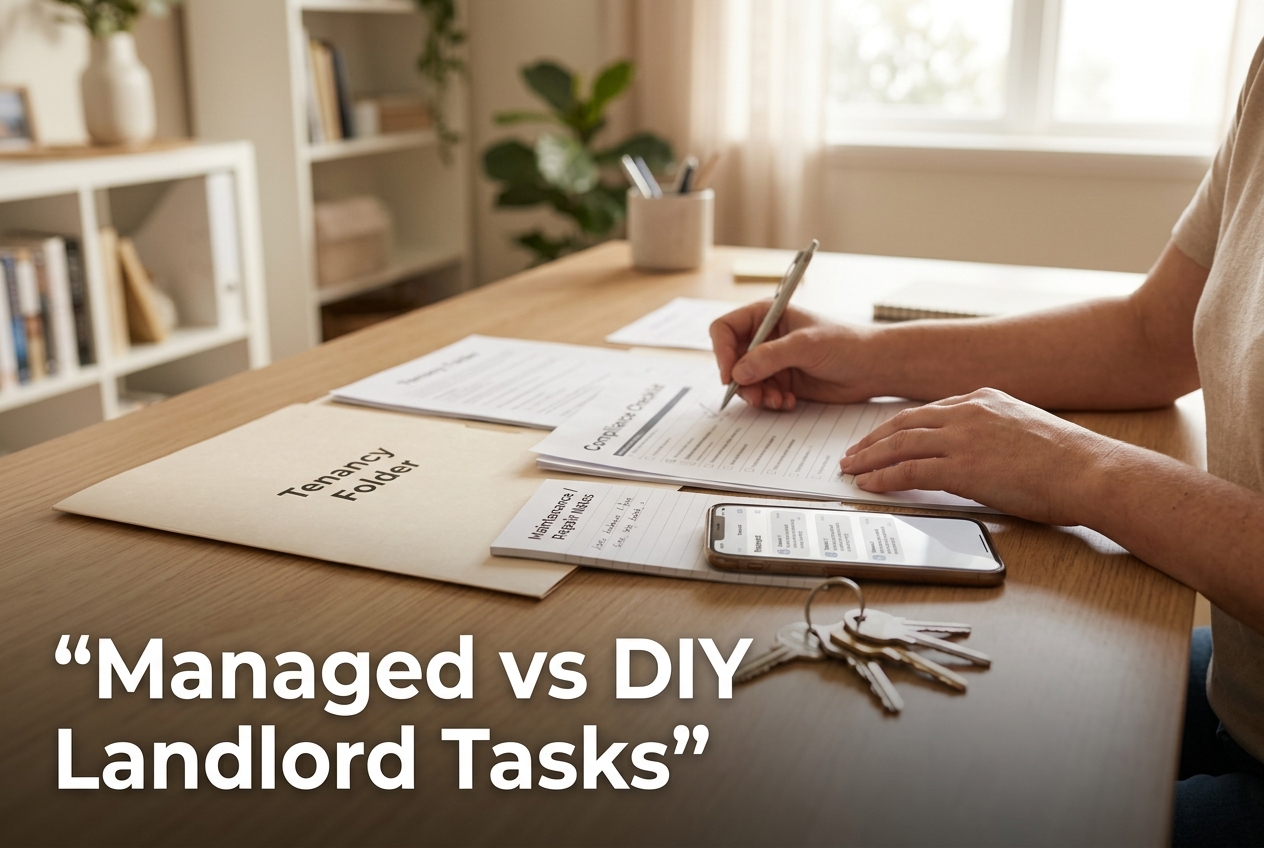
If you’re a time-poor landlord in or around Chester, this is the real question: do you want to keep running the day-to-day work yourself, or do you want a local team to take some of it off your plate?
That choice gets messy fast because it isn’t one decision. It touches tenant issues, maintenance and compliance, access, inspections, and how often you get pulled into the property when you’re trying to do something else.
Here’s the short version. Address vs self-managing comes down to capacity versus control. Address is the better fit when your main problem is operational load.
| Decision factor | Address | Self-managing |
|---|---|---|
| Day-to-day workload | Outsources tenant communication, site visits, maintenance coordination, and tenant finding/vetting. | You handle the full rental cycle yourself. |
| Tenant communication | Address maintains communication with tenants on your behalf. | You’re the first call for every message, complaint, and access request. |
| Maintenance | Address says it ensures maintenance is handled and conducts frequent site visits. | You triage, book, follow up, and record everything yourself. |
| Compliance confidence | Address says it keeps landlords informed about legislation affecting tenancies. | You track changes, interpret them, and keep the records. |
| Property oversight | Frequent site visits are part of Address’s service. | You set the inspection routine and see the property yourself. |
| Tenant finding | Address finds and vets suitable tenants. | You control marketing, referencing, and the final choice. |
| Cost | No public fee is published on the reviewed page. | No agent management fee, but you still pay in time and related costs. |
| Best fit | Time-poor landlords and growing portfolios. | Hands-on landlords with time, proximity, and strong admin habits. |
Address vs self-managing: what each route really changes
The hard part here is not finding a service. It’s deciding what you want to stop doing.
With Address, you’re buying operational support. The published service covers finding suitable tenants, vetting them, maintaining tenant communication, frequent site visits, property maintenance, and keeping landlords informed about new legislation affecting tenancies. That maps directly to the problems that wear landlords down: tenant issues, chasing repairs, and trying to keep up with rules that keep changing.
With self-management, you keep the authority and the workload. You choose the tenant, the contractor, the inspection timing, and the spending path. That can work well if you live close by, know your market, and have the time to stay on top of admin. It gets harder fast once the property is no longer a side task.
The key point is this. Address can reduce the number of things you need to chase. It does not remove your legal responsibility as landlord. If you self-manage, you keep the control, but you also keep every deadline, every record, and every escalation.
Address: where it helps most
Address is built for the landlord who is tired of being the default contact for everything.
Its published landlord service says it can:
-
Find suitable tenants
-
Vet tenants
-
Maintain communication with tenants
-
Carry out frequent site visits
-
Ensure property maintenance is handled
-
Keep landlords up to date on new legislation affecting tenancies
-
Provide information needed to rent out a property
-
Support both individual properties and portfolios
That is a useful set of services if your main pain is not strategy, but follow-through.
Where Address is ahead
The clearest advantage is coordination. If tenant issues are landing in your phone at the wrong time, Address gives those messages a different route. If small repairs keep slipping, frequent site visits and maintenance coordination help create a process instead of a pile-up. If you’re worried about missing legal changes, the legislation updates give you a buffer.
For a landlord in or around Chester, that local-service angle matters too. You do not want a property solution that only works if you are available in person all the time. Address is more useful when you need some operational presence without having to be on site yourself.
Where the limit is
The public page does not publish a fee, response-time promise, out-of-hours cover, contractor standard, or a full workflow for repairs and compliance. It also does not say exactly how often “frequent” site visits happen.
That does not mean the service is weak. It means you should not assume the parts you care about most are included in the way you picture them. Ask what happens with deposits, safety checks, reports, access, arrears, and escalation before you rely on the service.
Self-management: where it still makes sense
Self-management is not a light version of property management. It is the full job.
It includes marketing, viewings, referencing, the final tenant decision, right-to-rent checks, tenancy documents, deposit protection, safety work, repairs, inspections, arrears, notices, and check-out. That is why it can work for a landlord who wants direct control and already has the time and systems to do it properly.
Where self-management is ahead
The advantage is simple. You keep control of the tenant, the contractor, the timing, and the spend. If you live close to the property and can respond quickly, that can be a real strength. You may also prefer to deal with issues directly instead of waiting for an update from someone else.
For some landlords, that control is worth the effort. If you have one or a small number of straightforward properties, a steady contractor network, and a good record-keeping habit, DIY can still be the right call.
Where the limit is
Self-management has no backup unless you build one.
If you are busy, travelling, or pulled into your main job, tenant messages wait. Repairs wait. Compliance admin drifts. That is where small problems become expensive ones. The issue is not only time. It is the cost of missing something because the whole process lives in your head, your inbox, and your diary.
Maintenance and compliance: the part most landlords underestimate
This is where many landlords get stuck. They think the job is mostly collecting rent and booking a repair when something breaks. It is more than that.
A landlord has to track gas safety, electrical safety, alarms, deposits, right-to-rent checks, EPC rules, tenancy information, and the records that go with all of it. If you self-manage, all of that sits with you. If you use Address, some of the operational work is pushed away from you, but you still need to know what has been handled and what evidence you can expect back.
What the compliance load looks like if you self-manage
At a practical level, you have to keep track of:
-
Gas safety checks and records
-
Electrical inspection cycles
-
Smoke and carbon-monoxide alarms
-
EPC and MEES rules
-
Deposit protection
-
Right-to-rent checks
-
Tenancy information requirements
-
Repair records and access attempts
-
Notices, renewals, and check-out admin
That is a lot to hold in place when you also have tenant issues and maintenance to deal with. It is not impossible. It is just work, and it is work that punishes sloppiness.
What Address changes
Address says it keeps landlords informed about legislation affecting tenancies. That can lower the chance of missing a change. It also says it handles maintenance, maintains tenant communication, and carries out frequent site visits, which helps with the day-to-day side of compliance and property oversight.
What it does not do, at least based on the public page, is remove your legal duty or publish a full compliance guarantee. So the right question is not, “Does Address do compliance for me?” It’s, “Which checks and records are actually included, and how will I know they were done?”
Tenant issues: direct control or less interruption
Tenant issues are where the workload becomes personal.
A leak, a broken appliance, a complaint about access, a repair that keeps coming back, a tenant who stops replying. These are the things that make landlords feel they are always on call. If that sounds familiar, the route you choose matters more than the brochure.
Address and tenant issues
Address says it maintains communication with tenants on the landlord’s behalf. That means the landlord is not the first stop for every call, text, or complaint. That alone can change the rhythm of owning the property.
It also says it handles maintenance and makes frequent site visits. That matters because tenant issues and maintenance problems are often the same thing in disguise. A complaint is rarely just a complaint. It is often a sign that a repair needs follow-up, or that the same issue keeps returning because nobody owned the process.
Self-management and tenant issues
With self-management, you get first-hand information. That can be useful. You hear about problems directly and can act without waiting. But you also become the bottleneck if you are not available.
If a tenant is difficult, if access is awkward, or if the problem needs chasing, the whole load stays with you. That can work when you have the time and the local presence. It becomes a problem when you do not.
Property oversight and inspections
Address says it carries out frequent site visits to help keep the property in good condition. That is a strong fit for a landlord who wants oversight without personally making every visit.
The public page does not say how often those visits happen, what the report looks like, or whether photos are included. So the strength here is the existence of a routine, not a promise about its exact shape.
Self-management gives you full visibility because you are the one doing the inspection. That can be useful, especially if you know the property well. But it also means you have to create the schedule, give proper notice, attend, record what you saw, and follow through.
For either route, inspections matter because they catch the issues that tenants may not report, or may not report early. That includes damp, mould, leaks, damage, unsafe electrics, alarm problems, and signs that a repair has not really been fixed.
Comparison of the real trade-off
If you strip away the noise, the choice is this:
-
Choose Address if the problem is that the property is taking too much of your attention.
-
Choose self-management if the problem is that you want direct control and can handle the work.
Address is the stronger fit when your pain points are:
-
constant tenant messages
-
recurring maintenance issues
-
missed follow-up on small repairs
-
concern about keeping up with legislation
-
limited time during the working week
-
adding properties and losing operational grip
Self-management is the stronger fit when you:
-
live close to the property
-
have time to respond
-
already know your contractor network
-
are comfortable with admin
-
want to choose every tenant and contractor yourself
-
prefer saving the management fee over buying convenience
That is the decision in plain terms. Everything else is detail.
What the compliance comparison really means
A lot of landlords hope management removes risk. It doesn’t work that way.
Using Address may help you stay more organised, and it may reduce the chance of missing something. But the landlord still needs to understand what was delegated, who approved the work, who holds the records, and how problems are escalated. Self-management gives you the same legal duty with fewer layers in between, which can be good or bad depending on how disciplined you are.
Here are the main areas where that matters:
Gas and electrical safety
Someone has to track the dates, book qualified people, get the records, and make sure tenants receive what they should. A managed service may handle more of the logistics. A self-managing landlord has to keep the whole cycle in view.
Alarms
Someone has to confirm the right alarms are present, work on the first day of a tenancy, and get them repaired or replaced if faulty. If access is difficult, the landlord still needs a proper paper trail. That is easy to lose if you are juggling everything yourself.
Deposits and tenancy paperwork
Someone has to make sure the deposit is protected correctly and the right information is given to the tenant. Someone also has to handle the paper trail around the tenancy itself. If you use Address, ask who does what. If you self-manage, it is all on you.
Right to rent and updates
Right-to-rent checks, tenancy documents, and the newer information requirements all need proper handling. This is where many landlords feel the pressure most, because the rules are easy to know in outline and easy to miss in execution.
That is why compliance support can matter even when it is not legal advice. It helps reduce the mental load. It does not replace the landlord’s duty.
Address vs self-managing for portfolio growth
This is where the decision becomes less emotional.
A single property can be self-managed by a landlord who has the time and the habit. A growing portfolio changes the maths. More properties mean more tenant issues, more maintenance, more access coordination, and more chances to miss a deadline.
The landlord survey in the dossier points in the same direction. Agent use becomes more common as portfolio size grows. That doesn’t prove one route is better, but it does match how the workload behaves in real life.
So if your portfolio is growing and your current system is already creaking, that is a good sign that self-management may be costing you more than the management fee you are trying to avoid.
Questions to ask Address before you instruct them
If you’re leaning toward Address, do not leave the conversation vague. Get the scope clear before you sign anything.
Ask:
-
What exactly is included in tenant-find, part-management, and full management?
-
What are the fees, VAT treatment, minimum terms, renewal charges, and additional charges?
-
Who handles referencing and right-to-rent checks?
-
Who protects the deposit and sends the required information?
-
What does “frequent site visits” mean in practice?
-
Are photos and written inspection reports included?
-
How are repairs approved, tracked, and escalated?
-
What happens outside office hours?
-
What is the target response time for urgent and routine issues?
-
How are legislative updates delivered and recorded?
-
What evidence will you receive when something is done?
-
What stays with you as the landlord?
That’s the part worth your afternoon. The rest can wait a month.
Situation-based recommendation
Choose Weareaddress.com if you want to stay involved in ownership without being the one who has to chase every tenant issue, repair, and update. It is the better fit for time-poor landlords in or around Chester, landlords with growing portfolios, and landlords who want local operational support around maintenance and compliance.
Choose self-management if you live near the property, have time to stay on top of admin, know how to coordinate contractors, and want direct control over tenants and spending. It can work well. It just asks for more from you than many landlords first expect.
If you’re unsure, start with the question that matters most: do you need more control, or do you need more capacity?
FAQ
Is Address responsible for all of my landlord compliance?
Not automatically. Address says it keeps landlords informed about legislation, but the public page does not state that it takes over every legal duty. You should confirm what is included, what evidence you’ll get, and what remains your responsibility.
Is self-managing cheaper than using Address?
It avoids an agent management fee, but it is not free. You still pay for safety checks, repairs, contractor time, legal or professional help, travel, software, and your own time. Address does not publish its fees on the reviewed page, so you would need a quote to compare properly.
Who is responsible for repairs if I use Address?
The agreement should say. Address says it ensures maintenance is handled and maintains tenant communication, but the public page does not publish repair limits, contractor rules, or emergency cover. You should ask who approves work, who arranges access, and who follows up if the repair isn’t fixed first time.
Does a Chester landlord need an HMO licence?
Some do. Cheshire West and Chester Council says a licence is required for an HMO with five or more unrelated people sharing. You need to check the property’s actual occupancy and local rules, not guess based on whether it is a student let or a shared house.