
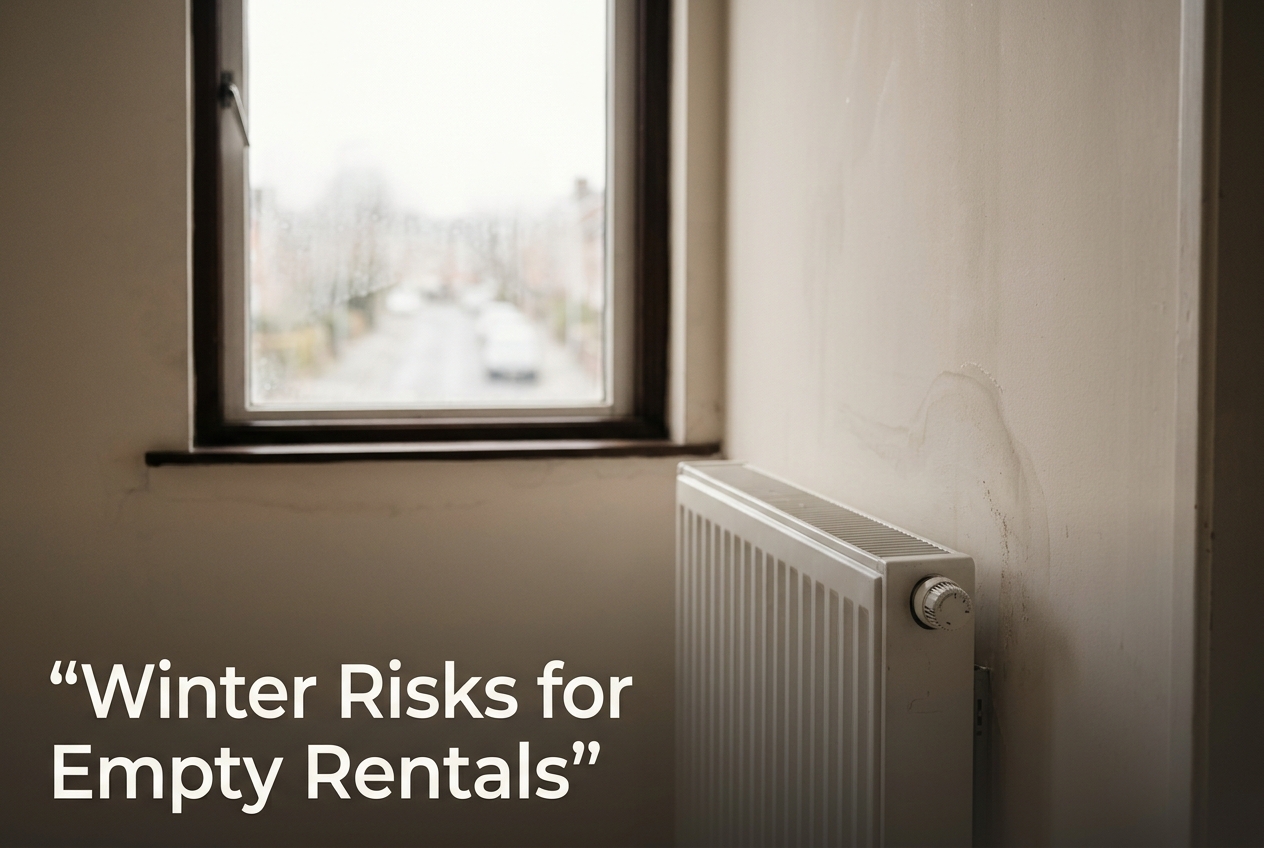
An empty rental property becomes riskier in winter because the building changes how it holds heat, moves moisture and gets observed. Cold, damp, frozen pipes, rainwater ingress and security issues can all become harder to spot, and a problem can sit longer before anyone notices it.
What changes when a rental is empty over winter?
The short answer is this: the property stops operating like a lived-in home, but winter still acts on it.
That matters in three ways. First, heating and ventilation may change when people leave, so cold surfaces and trapped humidity can create the right conditions for condensation, mould and decay. Second, winter weather puts more pressure on exposed pipes, roofs, gutters and external openings. Third, nobody is there every day to see a new stain, hear a change in water flow, or notice that something has gone wrong.
That is the core mental model. It is not that winter alone damages every vacant home. It is that winter exposure, building conditions and slower discovery all pile up at once.
If you manage a rental property in or around Chester, that is the part worth keeping in view. You do not need to treat every empty week like a crisis. You do need to understand what changes once the place is no longer being lived in.
Why can an empty property become damp?
An empty home is not automatically a dry home. In winter, the indoor environment can shift enough to make damp more likely, even when no one is cooking, showering or drying laundry inside.
The main issue is the balance between heat, ventilation and moisture. When a property is occupied, the air changes constantly. When it is empty, heating may run less, windows may stay shut, and the building may sit colder for longer. Cold surfaces make condensation more likely when moisture is present. Reduced ventilation makes it harder for that moisture to leave.
That is why winter property management is not just about keeping the place warm. It is about keeping the building in a condition where moisture does not settle and stay there.
There is one distinction people often get wrong. Vacancy does not automatically create more water vapour. In fact, daily moisture from people living there may drop. So the right conclusion is not “empty means wetter.” The right conclusion is that empty means the property’s moisture balance has changed, and cold, ventilation and existing defects matter more.
Damp itself is not one thing. It can come from condensation, but it can also come from leaking plumbing or rainwater getting into the building. A stain tells you there is a problem. It does not tell you which problem it is.
That’s the part that catches people out. They see a mark and assume it’s just condensation. Sometimes it is. Sometimes it isn’t.
Why are pipes and small leaks more concerning?
Frozen pipes are a winter risk because water-bearing pipework is still vulnerable even when nobody is using the taps.
Cold weather can freeze exposed or draughty pipework, especially in places like lofts, garages and outside areas. If that happens, the impact can go beyond a minor inconvenience. Pipes can burst, water supply can be lost, and damage can spread into walls, ceilings or finishes before anyone finds it.
Vacancy changes the picture because there is less background heat and less day-to-day supervision. A room that stays warm enough most of the time may not protect every exposed pipe elsewhere in the building. That’s why you shouldn’t read a single thermostat setting as a whole-house guarantee.
The same logic applies to small leaks. In an occupied property, someone may notice a new damp patch, a loss of water pressure, or a strange sound from the plumbing. In an empty rental property, that discovery can wait until the next visit. The fault may not be worse at the moment it starts. It just has longer to do damage before anyone responds.
And this is where winter makes the whole thing more consequential. Rain, frost-related plumbing damage and storm conditions can all create routes for water problems. A leak is one issue. A leak that sits unnoticed through cold weather is a different one.
What changes about security and insurance?
An empty property can look empty.
That sounds basic, but it matters. Unlit rooms, piled-up post, and no sign of movement can all advertise absence. In winter, when evenings are darker and properties sit quiet for longer, that visual signal becomes more relevant. Security is not only about locks. It is also about what the property appears to be telling the outside world.
The practical response is a combination of secure doors and windows, sensible lighting, timer switches where appropriate, and alarm systems where they are part of the setup. None of those things replaces the others. Lighting can help with appearance. It does not fix an unsecured opening. A lock helps with security. It does not tell you a pipe has burst inside.
Insurance is the other part people miss. Vacancy can change the conditions attached to cover. Some policies restrict certain insured events after a period of unoccupancy, and the details vary. The key point is not that every empty property loses cover. It is that the policy wording starts to matter more once the property is no longer being lived in.
That is why a landlord should not assume that a brief visit makes the property “occupied” for insurance purposes. It may not. The contract terms decide that, not habit.
What does winter climate in Chester and Cheshire add to the risk?
You do not need a dramatic weather story to see why this matters locally.
The North West gets repeated winter wet weather, and in the drier parts of Cheshire and Merseyside, the regional climate description points to around 35 to 40 wet days in winter. A wet day there means at least 1 mm of rainfall. The same regional picture also notes an autumn and winter rainfall maximum, with strong winds most common in the winter half of the year, especially December to February.
That does not mean every Chester rental faces the same flood or frost risk. It does mean winter wetting is normal enough that a vacant building can be tested again and again by the weather without any dramatic event. Prolonged rainfall can also be a problem where soils are already saturated.
So the local point is simple. A winter vacancy does not need snow to become riskier. Repeated wet weather and cold exposure are enough.
How do inspections help, and what can’t they do?
Inspections help by shortening the time between a change happening and someone learning about it.
That is the real value of a property visit. It can reveal a new damp patch, visible leak, damage to a gutter or signs of interference. It can also help a landlord judge whether the property is still being maintained in a reasonable condition while empty.
But a visit is not a shield. It cannot see hidden pipework. It cannot guarantee that every issue will be caught early. It also does not replace repair work.
This is where a lot of winter property management advice gets fuzzy. People want a single routine that solves everything. There isn’t one. A visit improves the odds that you spot trouble before it spreads. It does not make winter damage impossible.
Historic England’s vacant-building guidance supports the idea of regular monitoring, and a weekly walk-through is mentioned there as a useful reference point. That is not a universal legal rule for every rental property, and it is not the same as a guaranteed service level from any management company. It is just a reminder that emptiness needs observation, not hope.
What should you take from the insurance examples?
Take the limits seriously, not the exact numbers as a one-size-fits-all rule.
General home-insurance guidance from the Financial Ombudsman Service notes that many policies restrict cover after an unoccupied period, often 30 or 60 days, for events such as theft, malicious damage and escape of water. That is a useful warning, but it is not a universal landlord rule.
A separate policy example from a residential property owners wording shows how much variation there can be. In that wording, a building is treated as unoccupied after more than 90 consecutive days without anyone living there with permission, and winter conditions can include keeping heating on or draining the system during a defined winter period.
The lesson is not “pick one number and you’re done.” The lesson is that the policy wording, schedule and endorsements control the outcome. A landlord who assumes the insurer will treat any regular visit as occupation is taking a guess. That’s the part worth checking before winter, because the wrong assumption can be expensive.
What does this mean in practice for a landlord?
It means you should judge the property in three separate ways.
First, what is the building doing while it is empty? Is it staying warm enough in vulnerable areas, and is moisture likely to build up? Second, how will you notice change? If something starts leaking or dampness appears, what gets it in front of you quickly enough to matter? Third, what does the policy require? If the property is unoccupied under the insurance wording, the conditions may be different from normal tenancy life.
That is the sensible way to think about winter property management. Not as a long checklist. As a set of connected risks that get worse when no one is there to see them.
This is also where Address can help in the way that matters here. Address offers frequent site visits, tenant communication management and maintenance coordination, so problems are more likely to be noticed and followed up before they grow. That does not stop winter damage from ever happening. It does make the gap between “something changed” and “someone knows about it” smaller.
If your rental will be empty this winter, speak to Address about the property visits and maintenance coordination available under your management arrangement.
Frequently asked questions
Can an empty rental property develop damp even when nobody is cooking or showering?
Yes. Less household moisture does not remove the risk. The property can still get colder, ventilation may change, and leaks or rainwater ingress can still happen. The important thing is to find the cause, not assume every mark is condensation.
Should the heating be left on in an empty rental over winter?
Some background heating can help, but there is no single setting that works for every property. WaterSafe recommends at least 14°C when away, while some insurance wording uses different winter conditions, including a 10°C minimum in one example. The property, heating system and policy all need to be considered together.
How often should an empty property be visited in winter?
There is no single frequency that fits every rental. The insurance wording and the agreed management arrangement matter. Historic England mentions weekly walk-throughs in vacant-building guidance, but that is not a universal rule for residential rentals.
Does landlord insurance still cover an empty property?
It may, but cover and conditions can change once a property is unoccupied under the policy. Some policies restrict theft, malicious damage and escape of water after a set period. The wording has to be checked, because a visit does not automatically mean the insurer will treat the property as occupied.