
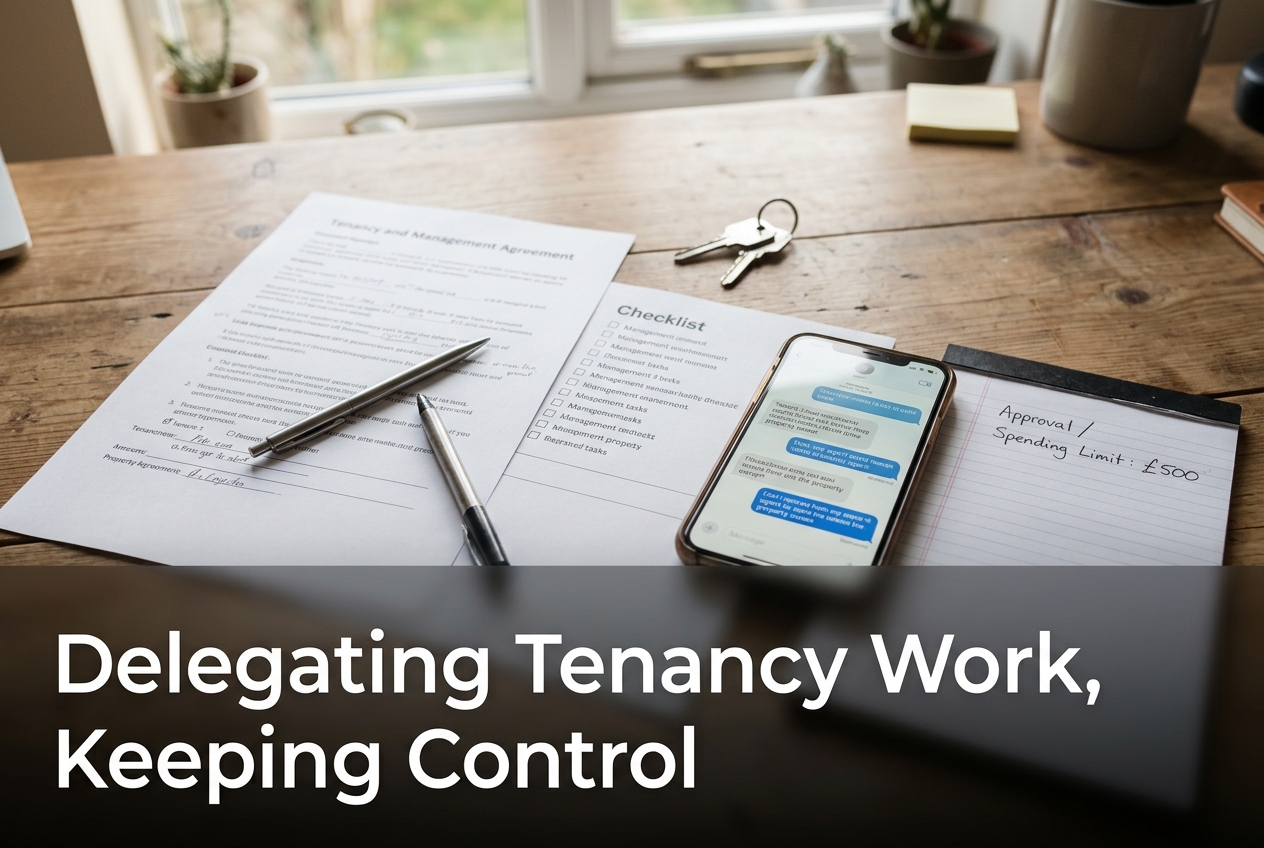
Moving from self-management to Address means handing over agreed day-to-day tenancy work, such as tenant communication, visits and maintenance coordination, while you keep ownership and agree how decisions, information and spending are handled. That is the practical model to aim for. It is not a promise of a published approval system or reporting portal, so those details need to be confirmed in the management agreement.
If you are a time-poor landlord, that is usually the real question. Not whether you can stop doing everything, but whether you can stop self-management without feeling cut off from your property.
What changes when you stop self-management?
What changes is the workload, not the ownership. You stop being the first call for routine tenant issues and you stop carrying the whole admin chain yourself. Address can take on tenant communication, site visits, maintenance coordination, tenant finding and vetting, and updates on tenancy legislation.
What should not change is your ability to stay informed. You still need to know what decisions are being made, what needs your approval, what has been done, and what records you can rely on later. That is the part many landlords miss. They assume the handover is mainly about handing over tasks. It is also about setting boundaries.
If you keep that distinction clear, the transition is much easier to judge. You are not asking, “Will I still be involved?” You are asking, “What stays with me, what moves to Address, and how do I get the right level of visibility?”
How the handover actually works
The simplest way to think about it is this: Address becomes the operational point of contact for agreed tasks, and you remain the owner who sets the rules around authority and visibility.
That framework matters because the public landlord material does not spell out a fixed workflow. It does not publish a standard inspection interval, a reporting template, a maintenance spending threshold, or a formal approval route. So you should not guess. You should ask.
A useful handover conversation covers six areas:
Tenant communication
Address says it maintains communication with tenants on the landlord’s behalf. That can take a lot of pressure off you, but only if you agree what sits with them and what comes back to you.
Ask:
- Which enquiries do they handle directly?
- What counts as urgent?
- When do they contact you?
- What gets recorded for your records?
That is the part that keeps you informed without making you the default inbox for every message.
Site visits and property condition
Address says it makes frequent site visits. That sounds useful, but the word “frequent” is not a schedule. It does not tell you how often visits happen, what they cover, or whether you get notes or photos.
Ask:
- How often will visits happen for this property?
- What is the purpose of each visit?
- Will you get written feedback?
- How are issues prioritised and followed up?
This is where most landlords either get more visibility than they expected or far less than they wanted. Better to settle it in writing.
Repairs and spending authority
Address says it coordinates property maintenance. That is useful only if you and the agent agree who can instruct work and when you need to approve it.
Ask:
- Who can authorise routine repairs?
- Is there a spending limit?
- When are quotes required?
- How are emergencies handled?
- How are invoices and completion confirmed?
If you do not set this boundary, you can end up with repairs moving faster than your comfort level or slower than the property needs.
Compliance visibility
Address says it keeps landlords informed about relevant legislation. That helps, but it is not the same as a compliance system.
Ask:
- Which certificates, renewals and notices will they track?
- Who books checks?
- Who keeps the evidence?
- How are overdue items escalated?
- How often will you be updated?
You want to know what they are watching, and what they expect from you. Do not assume legislative updates alone mean every obligation is being handled end to end.
Financial information
The landlord page does not publish a reporting format or schedule. That means you should ask for the financial rhythm before you sign.
Ask:
- What rent statements will you receive?
- How are arrears reported?
- What fee breakdowns are provided?
- What records arrive at year end?
If you are moving away from self-management because the admin is too heavy, this is one of the places to reduce that load without losing sight of the numbers.
If you are moving away from self-management because the admin is too heavy, this is one of the places to reduce that load without losing sight of the numbers.
Existing tenancy records
Before the handover starts, gather the records that matter. This is not a sign of mistrust. It is the cleanest way to avoid gaps.
Reconcile:
- tenancy agreement and any variations
- tenant contact details
- rent and arrears records
- deposit scheme information
- inventory and condition record
- safety documents
- open maintenance issues
- contractor details
- keys and access arrangements
That is the handover checklist that actually protects you. It is not a published Address intake list, but it is the practical one.
How do you stay informed without doing everything yourself?
This is the part worth your afternoon. The goal is not to stay involved in every message. The goal is to stay informed where it matters.
A good management setup lets you delegate routine work while keeping three things for yourself:
- visibility
- approval rights where needed
- access to records
That means you can let Address handle the day-to-day contact while still getting the information you need to make decisions. It also means you can set limits before the work starts, instead of trying to fix the arrangement later.
Here is the mental model to use. Address handles the operational task. You define the boundary. The contract should say who does what, who approves what, and what gets reported back.
If that sounds like work, it is. But it is the right kind of work. You do it once, then the day-to-day becomes lighter.
What do landlords most often get wrong?
The biggest mistake is confusing delegation with disappearing from the process.
A manager can take over agreed operational tasks. That does not mean your legal duties vanish. It also does not mean that a general promise of “full management” answers every practical question.
Three confusions come up again and again:
1. Operational management versus ownership
Address can manage the work around the tenancy. You still own the property. Those are different things.
You should not assume that appointing an agent transfers every responsibility. The agreement needs to say which tasks are delegated and which remain yours.
2. Client money protection versus deposit protection
These are separate protections. A client-money certificate is not the same thing as proper tenancy deposit handling.
That matters when the manager changes. The tenant’s deposit must stay protected throughout the tenancy, and the changeover needs to be handled as a records and protection issue, not just a contact change.
3. “Frequent” visits versus a published inspection standard
“Frequent site visits” sounds reassuring. It is still vague.
You need the actual arrangement for your property, because a vague promise does not tell you when issues will be spotted, how you will hear about them, or what happens after a visit.
If you are used to self-management, this is where the handover can feel slippery. It does not have to be. You just need the terms written down.
What happens if the property already has tenants?
This is one of the first questions to settle, because it changes the handover work.
Address’s public landlord material does not say whether it takes on already-occupied properties as standard. So ask directly whether it will accept the current tenancy, what records it needs, and how it will handle the move from your management to theirs.
If there is an existing tenancy, the deposit needs particular care. The deposit should remain protected for the whole tenancy, and the landlord or agent responsible for the tenancy needs to make sure the scheme details and responsibility are transferred or confirmed. The tenant should also receive written information about the scheme being used.
That makes the handover more than an admin swap. It becomes a records check. If you skip that step, you can create problems without meaning to.
For access and visits, the tenant’s rights still matter. Tenants must get at least 24 hours’ notice for inspections or repairs, unless it is an emergency. They also have the right to remain in the property during repairs. So if Address is going to be the operational contact, the access process still has to respect the tenancy, not just the schedule.
What stays with you when compliance moves to Address?
This is where landlords often feel most exposed, especially if they have been self-managing for a while.
Address says it will keep landlords informed about relevant legislation. That is helpful. It is not the same as legal advice, and it is not the same as a guarantee that every duty has been completed.
The practical point is simple. You need the contract to say how compliance work is divided.
Landlord duties in England include keeping rented properties safe and free from health hazards, ensuring supplied gas and electrical equipment is safely installed and maintained, providing an Energy Performance Certificate, protecting the tenant’s deposit in an approved scheme, checking right to rent in England, and fitting and testing smoke and carbon monoxide alarms.
Gas safety is a good example of why the division matters. HSE says the management contract should clearly specify who arranges maintenance and safety checks, and who keeps the records. If the agent is responsible for that work, the agent has the related duties under the gas safety rules for that work. HSE also says the landlord remains responsible for tenant safety and should ask for copies of maintenance information and safety-check records.
That is the right way to think about the handover. You can delegate the work. You do not delegate the need to know what has been done.
For gas checks, the schedule is every 12 months by a Gas Safe registered engineer. Records must be kept for two years, and the existing tenant must get a copy within 28 days of the check. New tenants should get it before they move in.
That kind of detail is exactly why “we keep you informed” is not enough on its own. You need to know how information moves, not just that it will.
What about the Renters’ Rights changes?
This is another area where you want clarity before the handover feels comfortable.
The GOV.UK landlord guidance says the Renters’ Rights Act changes took effect on 1 May 2026. Existing assured shorthold tenancies changed to assured periodic tenancies. New tenancies are also assured periodic tenancies.
The deadlines in that guidance have already passed. The Renters’ Rights Act Information Sheet had to be given by 31 May 2026, and if a tenancy was based entirely on a verbal agreement, written information about key terms had to be provided by then too.
If you are taking on management after that transition, do not assume the previous owner or manager handled it cleanly. Check whether the required information was delivered and keep evidence.
The GOV.UK overview also says section 21 “no fault” evictions ended, rent increases now use Form 4A with at least two months’ notice and no more than one increase per year, and rent bidding is restricted, including the requirement to advertise an asking price.
You do not need to become a law tracker again. You do need a clear answer on how updates like these are flagged, what action is taken, and who is responsible for recordkeeping.
That is the point of handing over to Address in the first place. You want fewer late-night checks and fewer surprises.
Does this change for student lets or HMOs?
It might, and this is where you should slow down.
Address identifies Bed Student Rentals as a sister business in Chester, but the reviewed material does not set out student-management terms or tenancy exceptions. Do not assume the same service arrangement applies to every property type.
If the property is an HMO, the local licensing rules matter too. Cheshire West and Chester Council says an HMO licence is required when five or more unrelated people are sharing. The council also describes licence conditions covering property management, fire safety, kitchen and bathroom facilities, room sizes and waste disposal. Eligible landlords accredited under the Cheshire Landlord Accreditation Scheme can get a 10% reduction on the HMO licence fee.
No current licence price was stated in the material reviewed.
So if your property has student tenants or shared occupation, check the exact setup before you hand anything over. A regular site visit or a general compliance update does not replace a licence.
What does Address publish about fees, complaints and client money?
Address’s landlord page asks landlords to contact it for service and fee details. It does not publish a management price, a letting charge, VAT treatment, a repair mark-up, or any other fee schedule in the material reviewed.
That means you should ask for the full fee structure before you make a decision. If you need to compare options, compare on the complete cost, not on a headline that leaves out the parts that matter.
Address does publish a complaints procedure. It says it aims to resolve concerns immediately or escalate them to a manager. It will acknowledge a complaint in writing within three working days and send a formal written outcome within 15 working days of the acknowledgement. If you are still unhappy, there is a separate senior review and then referral to Property Redress, membership number PRS055878.
That route is useful because it gives you a documented path if service slips. It is not a substitute for agreeing service levels in the first place, but it does matter.
The website also links a client-money-protection certificate. The extracted text names Address Sales and Lettings (Chester) Ltd and gives a validity date of 31 December 2026. The provider or scheme name is not visible in the text reviewed, so you should ask Address to identify the scheme and explain how it handles rent and other client money.
That distinction matters. Client money protection is separate from deposit protection. One does not prove the other.
What should you ask before you sign?
If you want to move from self-management without losing control, keep the pre-signing questions tight. You do not need a long list. You need the right list.
Ask Address:
- Will you take over an existing tenancy, or only new ones?
- How often will you visit the property?
- What do you include in a visit report?
- Who can approve repairs, and up to what amount?
- How are emergencies handled?
- What rent and compliance updates will I receive?
- What records do you keep and share?
- How are deposits handled during the handover?
- What fee schedule applies?
- What is the complaint process if something goes wrong?
If they cannot answer those clearly, you are not ready to sign. That is not a reason to keep self-managing forever. It is a reason to wait until the agreement is actually usable.
What can you judge for yourself now?
You can judge whether the proposed handover keeps you informed enough to stay confident.
That is the real test. Not whether Address sounds broad enough to cover the work, but whether the written scope gives you the right balance of delegation and control. You should be able to see who handles tenant contact, how often the property is reviewed, who approves spending, what compliance records are kept, and how you get updates.
If that is clear, the move away from self-management becomes much smaller than it looked at the start.
If you are considering a property in or around Chester, use that conversation to ask for the details in writing. Keep the focus on your property, your tenancy, and the boundaries you want in place.
FAQ
Will Address take over a property that already has tenants?
Its public landlord page does not say. Ask whether it will accept the current tenancy and what records it needs.
How often will Address visit my property?
It says it makes frequent site visits, but it does not publish a fixed interval. Agree the schedule and report format directly.
Will I have to approve every repair?
Not necessarily, but the public page does not set approval thresholds. Get the repair authority and emergency process in writing.
Do I stop being responsible for compliance once I appoint Address?
No. You can delegate tasks, but you should still know how compliance is being handled and keep evidence of what has been done.